— Credentials & Authority
Independently certified. Repeatedly verified.
Richard's PMII residential and commercial certificates are listed below. Industry organizations and published standards are separate reference resources; listing them does not mean Mold X is certified, accredited, or endorsed by each organization.
IICRC
References
ACAC
References
EPA
Compliant
OSHA
Compliant
CMI
References
CMA
References
IEP
References
AIHA
References
— Your Inspector
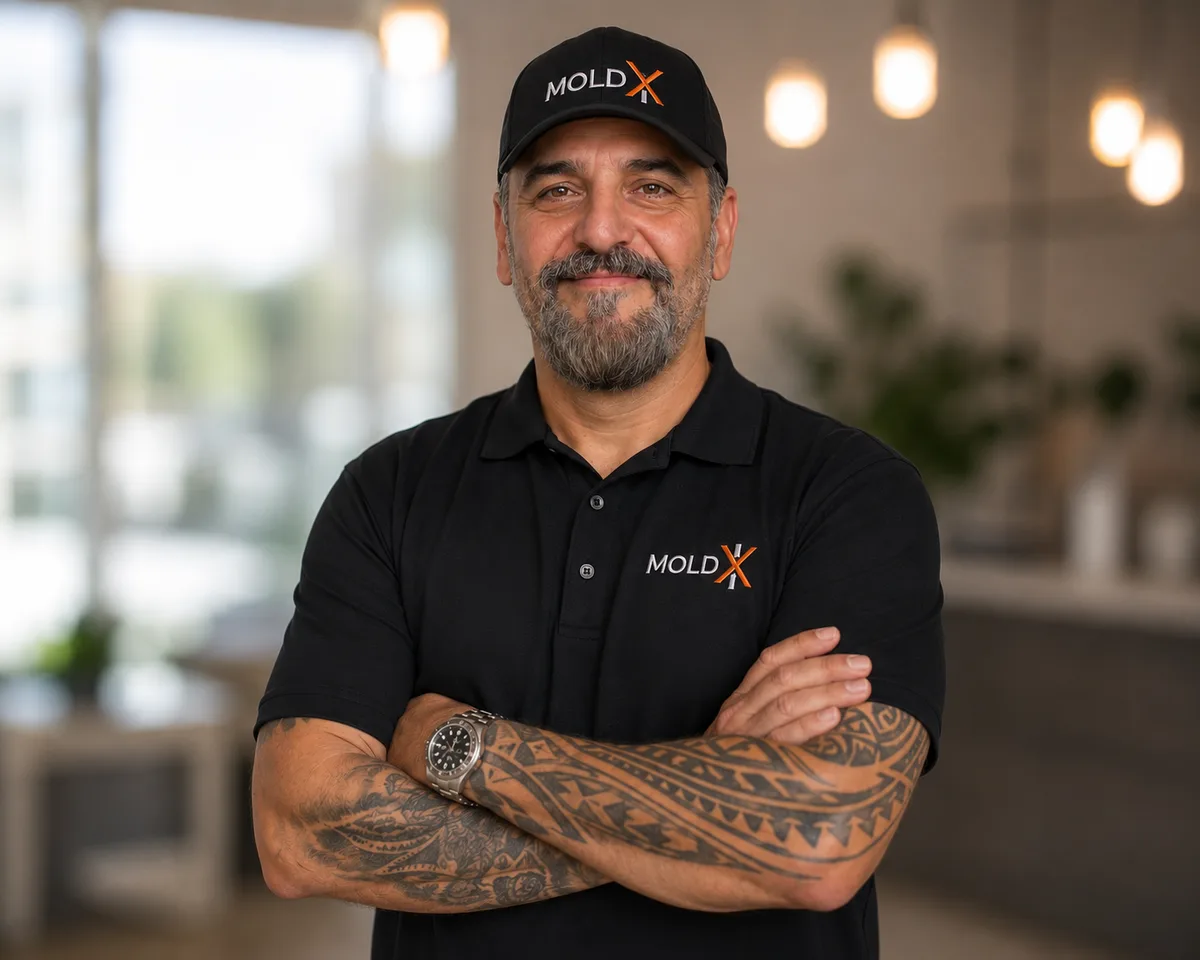
Richard Nelson K.
Every Mold X inspection is performed or supervised by a named, certified inspector — not an anonymous crew. Richard holds active residential and commercial mold inspection certifications from the Professional Mold Inspection Institute, with certificate numbers published below so any client, agent, or attorney can verify them. Richard personally reviews the inspection findings and explains the details to the client.
Certificate CRMI0000051499
Certified Residential Mold Inspector (CRMI)
Professional Mold Inspection Institute (PMII). Documented training and examination in residential mold identification, moisture diagnostics, sampling protocol, and reporting.
Certificate CCMI0000051524
Certified Commercial Mold Inspector (CCMI)
Professional Mold Inspection Institute (PMII). Documented training and examination in commercial and multifamily mold assessment, from apartment buildings to office and retail space.
— Credentialing Detail
What each credential means.
IICRC
ReferencesInstitute of Inspection, Cleaning and Restoration Certification
Publisher of ANSI/IICRC S520, an industry reference for mold remediation. Referencing this standard is not a claim of IICRC certification.
ACAC
ReferencesAmerican Council for Accredited Certification
Independent credentialing organization for environmental professionals. This reference is not a claim that Mold X holds ACAC credentials.
EPA
CompliantU.S. Environmental Protection Agency
All Mold X protocols align with current EPA guidance, including A Brief Guide to Mold, Moisture, and Your Home and Mold Remediation in Schools and Commercial Buildings.
OSHA
CompliantOccupational Safety and Health Administration
Field operations conform to current OSHA worker safety standards including 29 CFR 1910 General Industry and respiratory-protection requirements for the inspection environment.
Certified Mold Inspector
ReferencesCertified Mold Inspector Standard
A general credential category covering mold inspection. Richard's specific PMII residential and commercial certificate numbers are published on our Certifications page.
Certified Mold Assessor
ReferencesCertified Mold Assessor Standard
Specialized credentialing for mold assessment professionals operating to industry-standard protocols, scope-of-work documentation, and post-remediation verification.
Indoor Environmental Professional
ReferencesIndoor Environmental Professional Standard
Comprehensive credentialing in indoor air quality, mold, ventilation systems, and environmental health — covering the full diagnostic spectrum beyond mold alone.
AIHA
ReferencesAmerican Industrial Hygiene Association
AIHA reference standards drive all sampling protocols. We submit samples exclusively to AIHA-LAP (Laboratory Accreditation Program) accredited laboratory partners.
— Published Standards
The standards we operate under.
Every inspection scope, sampling protocol, and report we produce references one or more of the published industry standards below. We list the codes so clients, attorneys, insurers, and remediation partners can verify exactly what governs the work.
ANSI/IICRC S520:2024
Standard for Professional Mold Remediation
The leading consensus standard for mold remediation in the United States. Defines Conditions 1, 2, and 3, scope-of-work documentation requirements, containment levels, and post-remediation verification protocols.
EPA 402-K-02-003
A Brief Guide to Mold, Moisture, and Your Home
EPA homeowner reference document on mold identification, health implications, moisture management, and when professional assessment is warranted. Foundational reference for homeowner-facing communication.
EPA 402-K-01-001
Mold Remediation in Schools and Commercial Buildings
EPA guidance on mold assessment and remediation in occupied institutional and commercial settings. Defines remediation scope by contaminated-area size and worker-protection requirements.
AIHA Green Book
Recognition, Evaluation, and Control of Indoor Mold
AIHA's authoritative reference on indoor mold assessment including sampling strategy, interpretation, and reporting standards. Updated periodically and treated as the definitive professional reference.
ASTM D7338-14
Standard Guide for Assessment of Fungal Growth in Buildings
ASTM consensus standard on building inspection methodology for fungal growth assessment. Defines visual inspection protocol, moisture mapping, and condition documentation requirements.
29 CFR 1910
OSHA General Industry Standards
Federal worker-safety regulations applicable to inspection environments including respiratory protection (1910.134), personal protective equipment (1910.132), and bloodborne-pathogen awareness where relevant.
— Laboratory Partnerships
AIHA-LAP accredited analysis.
Mold X submits every sample to state-licensed, independently accredited laboratories — our primary partners are EMSL Analytical and LA Testing, both accredited under the American Industrial Hygiene Association Laboratory Accreditation Program (AIHA-LAP). Rush laboratory processing is not offered. Results are normally available approximately 24 hours after samples are delivered to the laboratory; Sunday closure may delay samples collected or delivered around the weekend.
Spore-trap analysis (Air-O-Cell, Allergenco-D, Micro5)
Indoor air spore concentration and species identification benchmarked against outdoor reference samples.
Direct microscopy (tape-lift, swab)
Surface sample identification confirming visible discoloration is fungal growth versus stain or non-fungal artifact.
Bulk material analysis
Substrate-incorporated sample analysis confirming penetration depth into building materials.
Culturable analysis (viable plating)
Species-level identification where viable spore counts inform remediation scope or post-remediation verification.
ERMI / HERTSMI-2 (Environmental Relative Moldiness Index)
DNA-based dust analysis quantifying 36 species against an EPA-developed national benchmark scale.
VOC and formaldehyde sampling
Paired with mold sampling where industrial-adjacent properties or new-construction off-gassing is suspected.
Independence
Mold X performs assessment only. We do not own a remediation company, do not receive referral fees, and do not benefit financially from any finding. Independence is structural, not aspirational.
Documentation
Every inspection includes a verbal explanation. Written recommendations or a written inspection report are available on request at no additional charge and emailed within 24 hours. When sampling is included, the client also receives the laboratory results, explanation, and recommendations.
Continuing Education
Standards evolve. ANSI/IICRC S520 was updated in 2024. EPA guidance is periodically revised. We complete annual continuing education on every standard governing our work and update internal protocols within thirty days of publication.